

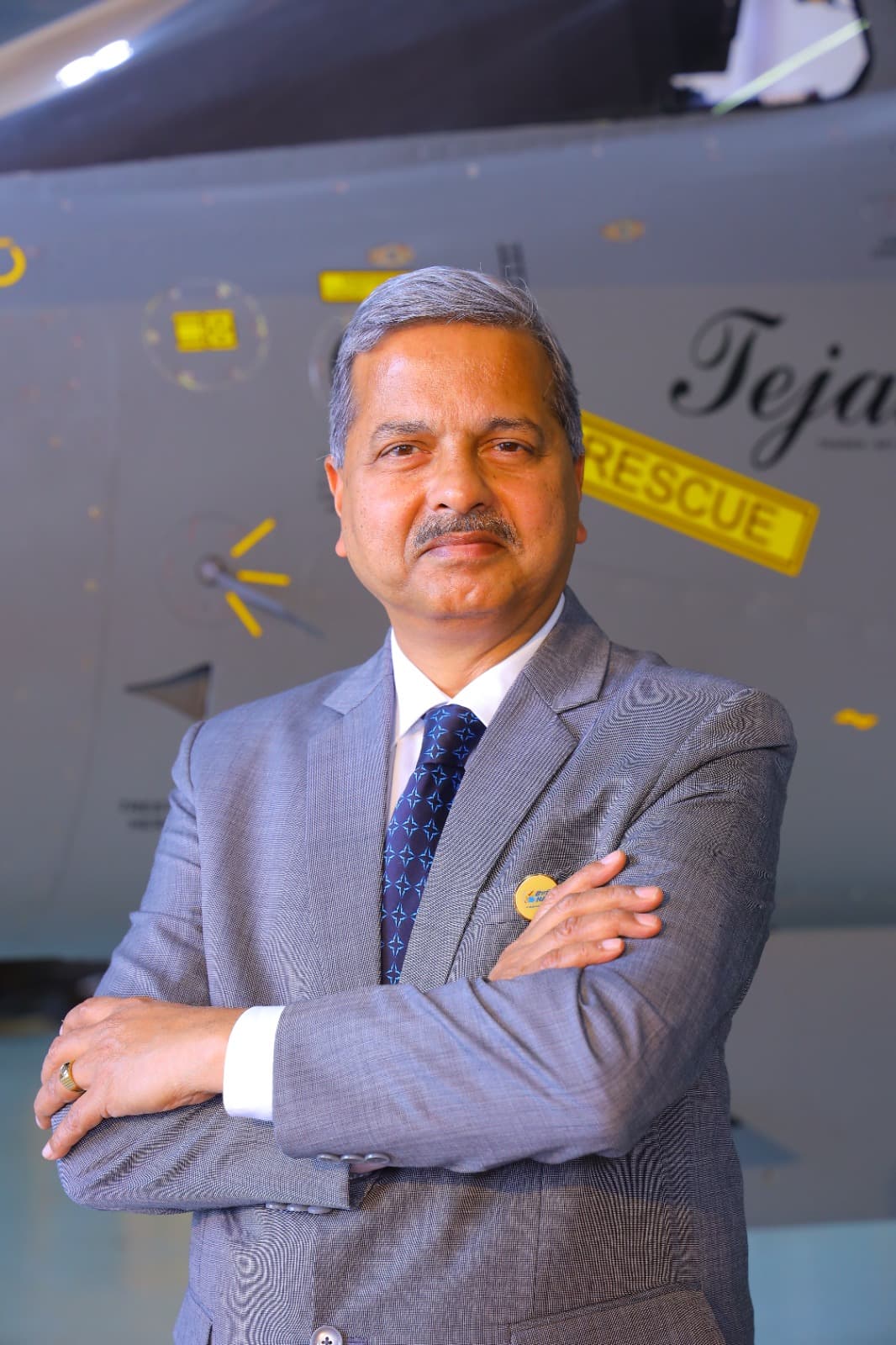
CMD, Hindustan Aeronautics Limited
Hindustan Aeronautics Limited (HAL), India’s first Maharatna Defence PSU, continues to play a defining role in shaping the nation’s aerospace and defence ecosystem. With a strong focus on indigenous design, innovation, and global competitiveness, HAL is advancing next-generation aircraft and helicopter programs while expanding its presence across international markets. In an interview with Arabian Defence, Dr. D. K. Sunil, Chairman & Managing Director, HAL, discusses the company’s expanding global footprint, its key focus at the Dubai Airshow 2025, and HAL’s roadmap for innovation, diversification, and strategic partnerships that aim to position India as a global aerospace hub.
As India’s first Maharatna Defence PSU, how do you see HAL’s role in advancing the nation’s defence and civil aviation capabilities?
Hindustan Aeronautics Limited (HAL) views its Maharatna status as both a recognition of its achievements and a mandate to become a global leader in aerospace and defence.
HAL perceives its primary role as establishing India's complete self-reliance in defence aviation, a commitment reflected in its strategic positioning around Aatmanirbhar Bharat.
The company's mandate centers on developing next-generation combat platforms that eliminate external dependencies. The Light Combat Aircraft (LCA) Tejas program exemplifies this vision, transitioning from development cycle to production, with 180 Tejas Mk1A aircraft on order.
HAL recognizes that true self-reliance requires building a robust domestic aerospace ecosystem. The company is driving indigenization across its entire platform portfolio, targeting increased indigenous content in flagship projects such as the LCA Mk1A, Prachand Light Combat Helicopter, and Light Utility Helicopter.
For the LCA Mk1A program, HAL has implemented a production model in which private sector partners manufacture major structural assemblies, including the front fuselage, centre fuselage, wings, and others. This approach simultaneously enhances production capacity and enables HAL to focus on its core competency of platform integration, while transferring critical manufacturing expertise to Indian firms and establishing sustainable domestic capabilities.
HAL demonstrates extraordinary commitment to long-term capability development through substantial Research & Development (R&D) investment. R&D expenditure over the past ten years is approximately ₹19,281 Cr., representing 8-9% of our annual revenue. Considerable expenditure is also planned for the future. To date, we have filed more than 2,625 IPRs. 1,133 IPRs have been granted to date, including 375 Patents.
This R&D focus has yielded indigenous technologies, including advanced avionics, flight control systems, mission computers, etc., developed across HAL's specialized centers. In the civil aviation sector, HAL has already supplied Do-228 civil aircraft, which are currently operating with Alliance Air in the north eastern sector.
Recognizing the rapidly growing civil aviation market, a Memorandum of Understanding (MoU) was signed this year with Russia's United Aircraft Corporation to manufacture the SJ-100 civil commuter aircraft in India.
HAL's vision is to serve as a comprehensive domestic supplier while achieving global competitiveness. We recognize that the Indian armed forces require the accelerated induction of indigenous platforms, and we are accordingly positioning ourselves as the "lead aerospace integrator," where we maintain our core competencies in design, integration, and flight testing.
HAL has established its presence in over 25 countries across different continents. How do you see HAL’s role in enhancing India’s global footprint in defence manufacturing?
Over the years, HAL has exported its platforms, work packages, avionics, rolled rings, aircraft repairable Spares, and services to over 30 countries. This includes Advanced Light Helicopter (ALH) Dhruv, Do-228, H-228, Cheetal, Chetak, Cheetah and Lancer helicopters. HAL has identified export as one of its focus areas, without compromising its basic commitment to the country's defence requirements.
HAL has appointed more than 20 Local Channel Partners in various countries globally, with special focus on South-East Asia, Africa and Latin America. Furthermore, a few more Channel Partners are in the process of being appointed. HAL has Liaison Offices in London, Moscow and Malaysia for dealing with foreign OEMs and Customers. Recently, HAL has exported H-228 Aircraft to a Latin American Country (Guyana).
Aircraft such as the Tejas and Light Combat Helicopter have drawn significant global attention through international air shows. Could you share the international response to these indigenous platforms?
The LCA Tejas and Light Combat Helicopter have been designed to meet the stringent requirements of the Armed Forces and have significant export potential. HAL’s range of products, including the LCA, LCH, Do-228/H-228, and ALH, has generated significant interest among foreign customers. HAL is targeting countries in Latin America, Southeast Asia, the Middle East and Africa for exporting its platforms. We are in advanced stages of discussion in some of these countries.
What are the key highlights of HAL’s participation in the Dubai Air show this year, and what priorities has the company set for this event?
The India Pavilion is being set up at Stand No. 1065 at the Dubai Air Show, with a focus on showcasing digital displays of Indian defence capabilities. HAL is participating as an exhibitor under the India Pavilion. HAL will be exhibiting scaled models of Light Combat Helicopter, HTT-40 and H-228 aircraft to showcase its manufacturing, design & development and MRO capabilities. HAL will also digitally display its LRUs, Accessories, and Systems.
Looking Ahead, what is your vision for HAL’s future in terms of diversifying the market, driving innovation, and building strategic partnerships to strengthen its global industry presence?
HAL envisions transforming from India's premier aerospace manufacturer into a globally competitive, innovation-driven enterprise by the next decade, achieving this through market diversification, technology leadership in next-generation platforms, strategic private sector collaboration, and international expansion across defence and civil aviation sectors.
a: Diversification
HAL is entering into entirely new sectors, fundamentally diversifying its business model from a defence-centric one. The space technology sector represents our most transformative diversification initiative. In June 2025, HAL won ISRO's bid to acquire Small Satellite Launch Vehicle (SSLV) technology, marking a transition from an aerospace systems/component manufacturer to a comprehensive launch service provider. It is anticipated that there will be considerable demand for SSLVs over the next decade.
In the Civil aviation sector, we envision significant market potential, with over 200 regional jets required in India over the next decade and more than 350 across the Indian Ocean region. The MoU with Russia's United Aircraft Corporation to manufacture SJ-100 regional jets represents our entry into civil passenger aircraft production after decades following our experience with the AVRO HS-748 and Do-228. This partnership enables progressive localization of fuselage sections, wiring harnesses, interiors, and the establishment of engine maintenance and pilot training ecosystems, leading India into global civil aerospace supply chains while addressing domestic regional connectivity under the UDAN scheme.
In the rotary wing segment, HAL is developing the Dhruv NG, equipped with an indigenous Shakthi engine, a glass cockpit, and AS4-compliant systems, for superior performance and safety.
b: Innovation
HAL's innovation roadmap focuses on developing Manned-Unmanned Team systems (MUM-T), unmanned combat aerial vehicles (UCAVs), advanced propulsion systems, and network-centric warfare capabilities —technologies that will define the next decade in airpower.
c: Strategic partnerships
We maintain strategic collaborations with global aerospace leaders to access cutting-edge technologies while building India's capabilities. The Safran partnership demonstrates this approach. Having jointly developed the "Shakti" helicopter engine that powers the Dhruv and LCH, the partnership now extends to co-designing IMRH engines. We are also manufacturing critical forged turbine parts for Safran's LEAP commercial engine. This positions HAL in global civil aviation supply chains while enabling access to advanced propulsion technologies.
Looking ahead, HAL envisions itself not only as India's largest aerospace manufacturer but as a global aerospace integrator, developing and interacting with an ecosystem of private partners, technology collaborators, academic institutions, and international suppliers to deliver cutting-edge platforms spanning defence, civil aviation, space launch services, and unmanned systems.
This vision reflects our commitment to making India not just self-reliant, but also a preferred global partner for aerospace solutions, thereby fundamentally reshaping the nation's strategic autonomy and industrial capabilities.